

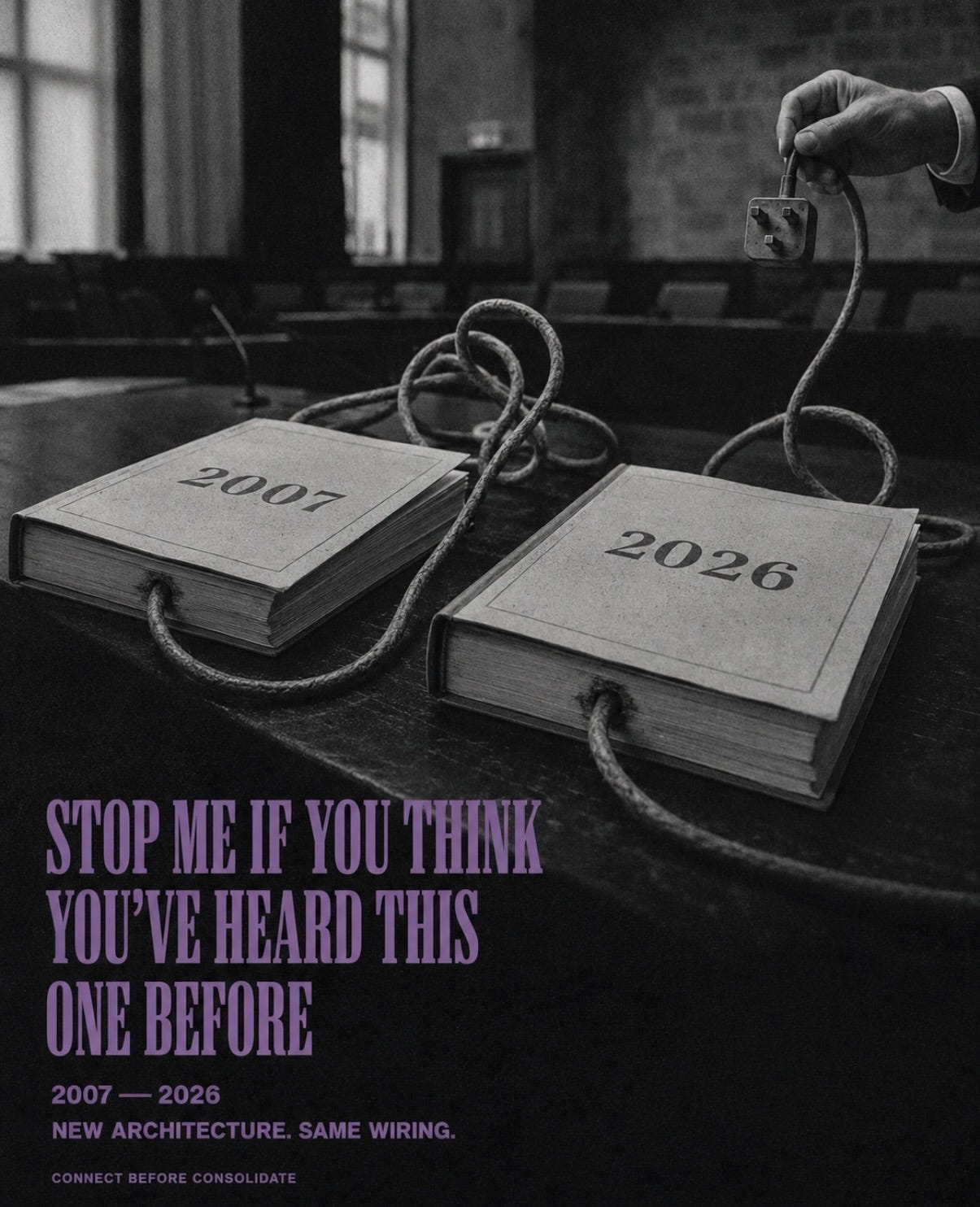
I’ve been reading a document from 2007.
Purple typography. An IDeA compliment slip still tucked inside. The LGA’s Prosperous Communities II: Vive la Dévolution!. It asked for 34 things.
Skills boards run at the right level. Buses under local control. A say over the railways. Money in one pot instead of a hundred bidding rounds. Housing decisions made across real housing markets. A local tax base worth the name.
And one genuinely radical idea about who should decide whether power moves.
Not ministers. Parliament.
Now read the Government’s Rewiring the State, published on 31 July 2026.
The language is new. The list is not.
Stop me if you think you’ve heard this one before.
The riff you already know
The 2007 report had a phrase for the way Whitehall treated local government, it was the obstacle course.
Hoops and hurdles. Governance questions turned into a “shibboleth”another reason to say not yet. Another reason to require one more board, one more assurance, one more signature. Its test for new local arrangements was beautifully unpretentious: “not perfect or ideal: just good enough to do the job”.
Local governance only had to be better than the centralised status quo. It did not have to achieve a standard of perfection that Whitehall had never achieved itself.
Nineteen years on, the hoops are still there. Fewer, perhaps. Shinier, yes, but still held by ministers.
Little by little
I’ll be fair, because I’m not saying that nothing has changed.
Greater Manchester runs its buses again, under public control for the first time in almost forty years. Integrated settlements have replaced more than twenty separate funding pots in Greater Manchester and the West Midlands. Skills budgets are moving. Strategic authorities have statutory functions. The Government has adopted devolution by default as an operating principle.
That is real progress and it is great to see, but look at how it arrived.
Deal by deal. Tier by tier. Signature by ministerial signature, and increasingly through one preferred model of governance.
The 2007 report wanted powers to be available to any sub-regional partnership capable of doing the job. What we have built instead is a ladder on which the strongest powers sit at the mayoral end.
Little by little. Power released in slivers, on Whitehall’s timetable and in Whitehall’s preferred shape.
The permission of no-one
The best part of the 2007 report is the part almost nobody remembers.
It imagined a place called Barchester.
Barchester had ambitions: a new road, better buses, a reopened rural station and training designed around local employers. Under the arrangements of the time, it needed the permission or agreement of nine bodies above it. These were the Highways Agency, Network Rail, the Department for Transport, the Government Office, the Regional Assembly, Jobcentre Plus and DWP, the Learning and Skills Council and the Regional Development Agency.
The report even allowed itself a joke: “it is only reasonable to assume that Barchester will not be led by a Bonaparte”. Then it described the alternative. Barchester and its neighbours would make one plan for land, transport and skills. They would fund it from one pool. They would keep the welfare savings and the growth in the business rate.
And to do it, they would require the permission of:
“No-one.”
That is the Barchester test. Whose permission do you still need?
Ask it of any English area in 2026.
Greater Manchester, the most devolved place in England, still negotiates its settlement. New powers still require national legislation or ministerial action. Fiscal retention still comes with equalisation and national rules.
It fails the test. Everyone fails the test. But not everyone fails it equally.
One country, three speeds
The emerging settlement creates three versions of devolved England.
Established mayoral strategic authorities receive the broadest powers, integrated settlements and the promised share of income tax from 2028.
Non-mayoral foundation authorities such as Lancashire receive useful powers over areas including transport, skills and growth, but not an integrated settlement or the same fiscal offer. Places without a strategic authority must first create the architecture through which further powers may arrive. The Government says every part of England should have a strategic authority by the end of 2028. It says it will not impose mayors on places that do not want one.
It also says, in the same policy, that the suite of powers available to mayoral areas will be “commensurately greater”. That is a local choice with a price attached.
Local choice or mayoralism by inducement?
This is not an argument against mayors. Mayoral leadership has helped some places make progress that would otherwise have been impossible. It is an argument against making one constitutional model the toll gate for local agency.
Wherever somebody lives, they should not have to wait in the slow lane simply because their area has chosen a different form of democratic leadership or has not yet been permitted to build the required institution.
Rewiring, or rewording?
Rewiring the State is the most serious attempt yet to address the problem.
The fact that it is Cabinet Office-led matters. Previous devolution programmes were too easily treated as the property of one department and politely ignored by the rest of Whitehall. Its fiscal ambition matters too - greater business-rates retention from 2027, a share of income tax for mayors from 2028, an overnight visitor levy and a fiscal roadmap due this autumn.
But precision matters.
Retention and assignment are not the same as fiscal autonomy. Equalisation is necessary in a country with profoundly unequal tax bases, but a local tax that remains subject to national design, national rules and national adjustment is not wholly local.
And the largest constitutional question remains open.
The 2007 report argued that Parliament should be the gatekeeper for devolution because “we should not be asking ministers to take decisions to strip themselves of their powers”. That insight has aged rather well.
The 2026 settlement makes devolution the default, but ministers still shape the framework, determine the tiers and control many of the routes by which powers move.
The language has shifted from deals to default. The gatekeeper has not shifted far enough.
Agency, not architecture
Which brings me home.
Lancashire is moving from fifteen councils to four. The new unitaries are expected to take responsibility for services on 1 April 2028.
I am helping to build the new East Lancashire authority, bringing together Blackburn with Darwen, Burnley, Hyndburn, Pendle and Rossendale. I want it to succeed.
There is a real prize here. One council can join services that residents currently experience as fragments. It can connect housing, public health, economic development, social care and neighbourhood services around people rather than organisational boundaries. It can build new capability rather than simply combine old structures. But a bigger council is not necessarily a more powerful one.
Its creation still depends on Parliament. Its powers will still be prescribed nationally. Its financial room to act will still depend heavily on decisions made in Westminster and Whitehall.
Run it through the Barchester test and it fails on day one.
That is the danger in front of us. Consolidation without agency. New architecture. Same wiring.
The answer is not to reject reorganisation. It is to refuse to confuse structural change with devolution.
One changes the map of institutions.
The other changes who is allowed to decide.
The challenge comes back to us
There is a challenge here for local government too.
We have spent years arguing that Whitehall should trust local leaders because we understand our places, can join things together and are directly accountable for the consequences.
We are right.
But those arguments do not stop being true when power reaches our own front door. If strategic authorities receive power from Whitehall and keep it at the regional centre, they will reproduce the behaviour they criticised.
If new unitaries use their scale to centralise every decision, standardise every relationship and treat the former boroughs simply as administrative outposts, they will do the same.
This is where the neighbourhood argument matters, but it is the consequence, not the whole story.
New Local’s work on community power and IPPR North’s call for democracy “within walking distance” both point in the same direction, institutions need scale, but legitimacy and connection have to be built closer to where people live.
That does not mean pushing every function to the smallest level. It means applying the same principle throughout the system. Decisions should sit at the lowest credible level, and the tier retaining them should be able to explain why.
Devolution by default should work all the way down. Otherwise we will replace one centre with several smaller ones.
The autumn test
The autumn fiscal roadmap is therefore the real test of whether this is rewiring or another round of rewording.
Does retained growth reach non-mayoral strategic authorities and the new unitaries, or mainly the mayors?
Do councils gain genuine freedom to combine money around local outcomes, or simply larger grants with new reporting requirements?
Will places without strategic authorities receive a clear route to powers, or remain outside the room until their governance matches the preferred model?
Will new local institutions be trusted to pass decisions further down—or merely encouraged to consult?
Above all: how many permissions disappear?
That is the Barchester test.
Not how many powers appear in a framework.
Not how many new bodies appear on an organogram.
Not how many times a document says “local”.
Whose permission do you still need?
Nineteen years. Two long periods of government from each party. The same refrain.
Stop me.
Oh—but you’ve heard this one before.